“Children are not good at pretending. If they feel small, they show it. If they feel powerful, they show that too.”
A mother stood outside the preschool gate long after the school day had ended.
She wasn’t waiting for her child.
Her child had already run out of the classroom twenty minutes earlier, proudly carrying a paper crown that looked as though it had survived a small natural disaster. Glue hung from one side. One sticker was upside down. The crown leaned dramatically to the left.
The child loved it.
The mother loved something else.
Three months earlier, that same child had refused to enter the classroom without holding her hand. Conversations with unfamiliar adults ended in silence. Group activities were avoided. Every new situation produced the same expression: uncertainty.
Now, the child was leading three friends towards the gate while enthusiastically explaining the story behind a crooked paper crown.
The crown was not what had changed.
The child had.
And perhaps this is one of the most misunderstood aspects of preschool education.
When parents search for the best preschool in whitefiled, they often ask sensible questions. What curriculum does the school follow? How experienced are the teachers? What is the student-teacher ratio? How does the school prepare children for mainstream schooling? Does the preschool focus on phonics? What are the learning outcomes?
Yet beneath all these questions sits another question that is rarely asked directly.
How does a child learn to believe in themselves?
Not academically.
Not theoretically.
Not through motivational slogans.
But genuinely.
Because confidence is a strange thing.
Adults talk about confidence as though it is a skill. Something that can be taught, instructed, or downloaded through encouragement. Yet confidence does not usually arrive through teaching. Confidence arrives through experience. It is accumulated slowly through hundreds of small moments that seem insignificant while they are happening.
A child puts up a hand in a group discussion for the first time.
A child walks into a classroom without looking back at a parent.
A child asks a question and discovers people listen.
A child builds something, watches it collapse, and decides to try again.
A child disagrees with a friend and learns that friendships survive disagreements.
A child sings loudly even though they are not sure they know the words.
No single moment creates confidence.
But together, they create a powerful message:
“I can.”
Modern education often speaks about academic readiness. The phrase appears in brochures, admissions presentations, websites, and parent meetings. School readiness has become one of the defining aspirations of preschool education. Children are expected to develop foundational literacy, numeracy, attention skills, and classroom routines that will support future learning.
These things matter.
But there is another form of readiness that receives far less attention.
Life readiness.
Life readiness is not measured by how many letters a child recognises.
It is measured by what happens when the child encounters uncertainty.
Can the child enter an unfamiliar room?
Can the child communicate a need?
Can the child recover from disappointment?
Can the child solve a small problem independently?
Can the child trust themselves?
These capacities rarely appear on report cards, yet they shape almost every future experience.
The irony is that many successful adults can still remember the moment they first felt capable. Not because someone gave them a lecture on confidence. Not because someone handed them a certificate. But because they experienced themselves succeeding at something they previously thought was impossible.
Confidence is evidence.
Children need evidence too.
This is why the environment of a top preschool in whitefiled matters so profoundly.
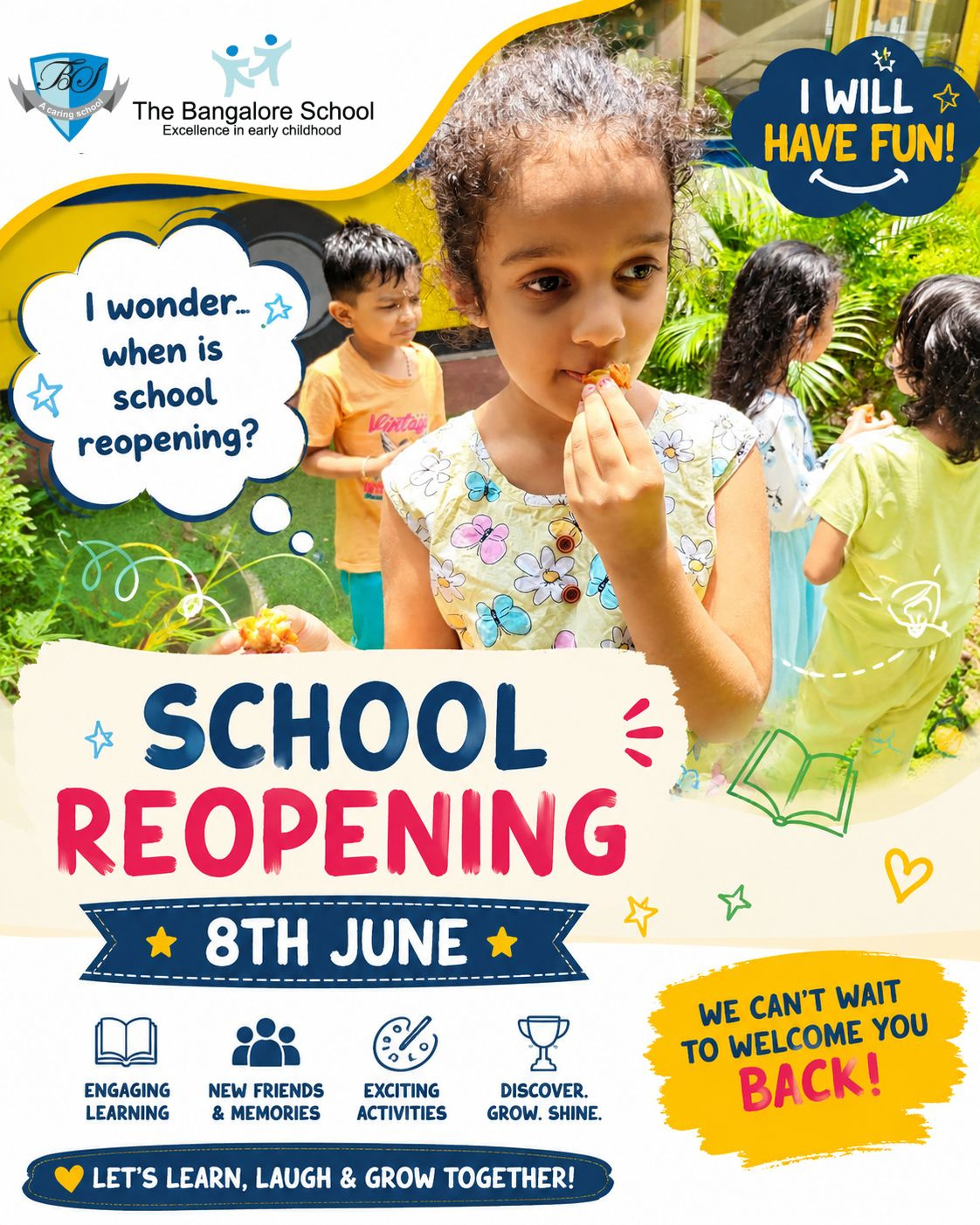
At The Bangalore School, confidence appears to be treated not as an outcome but as a process. The focus is not simply on what children learn. The focus is on how children experience themselves while learning. A classroom is not merely a place where information is delivered. It is a place where identity is being formed.
Every day, children are collecting clues.
When adults patiently listen to their ideas, children collect evidence that their voice matters.
When teachers encourage exploration rather than immediate correction, children collect evidence that mistakes are survivable.
When friendships are supported rather than managed excessively, children collect evidence that they can navigate relationships.
When children are trusted with responsibility, they collect evidence that they are capable.
These clues eventually become beliefs.
And beliefs eventually become identity.
The first five years of life are extraordinary because children are not simply learning about the world. They are deciding who they are within it. They are forming conclusions about whether they are brave, capable, valued, creative, intelligent, resilient, or important.
The conclusions are rarely dramatic.
They emerge quietly.
A little at a time.
One experience after another.
This is why confidence may be one of the greatest gifts a preschool can offer.
Not confidence as performance.
Not confidence as loudness.
Not confidence as attention-seeking.
But confidence as self-belief.
The quiet belief that says:
“I can try.”
“I can learn.”
“I can recover.”
“I can contribute.”
“I belong here.”
Years from now, children may not remember the worksheet they completed on a Tuesday morning in preschools bangalore. They may not remember the exact letter they learned or the number they traced.
But they will carry something far more enduring.
The story they began telling themselves about who they are.
And perhaps that story is the most important curriculum of all.