Education is not the filling of a pail, but the lighting of a fire.” — William Butler Yeats
There was a time when education was designed for predictability.
Children sat in rows.
Knowledge moved in one direction.
Silence was considered discipline.
Uniformity was considered success.
The system was built to prepare human beings for industrial structures where repetition, obedience, and standardisation were rewarded.
But the world children are entering today is profoundly different.
Artificial intelligence can retrieve information within seconds.
Algorithms can automate patterns.
Machines can increasingly replicate structured cognitive tasks.
Yet there remains something deeply human that technology still struggles to replace:
the ability to feel deeply,
understand meaningfully,
connect authentically,
reflect honestly,
and coexist compassionately.
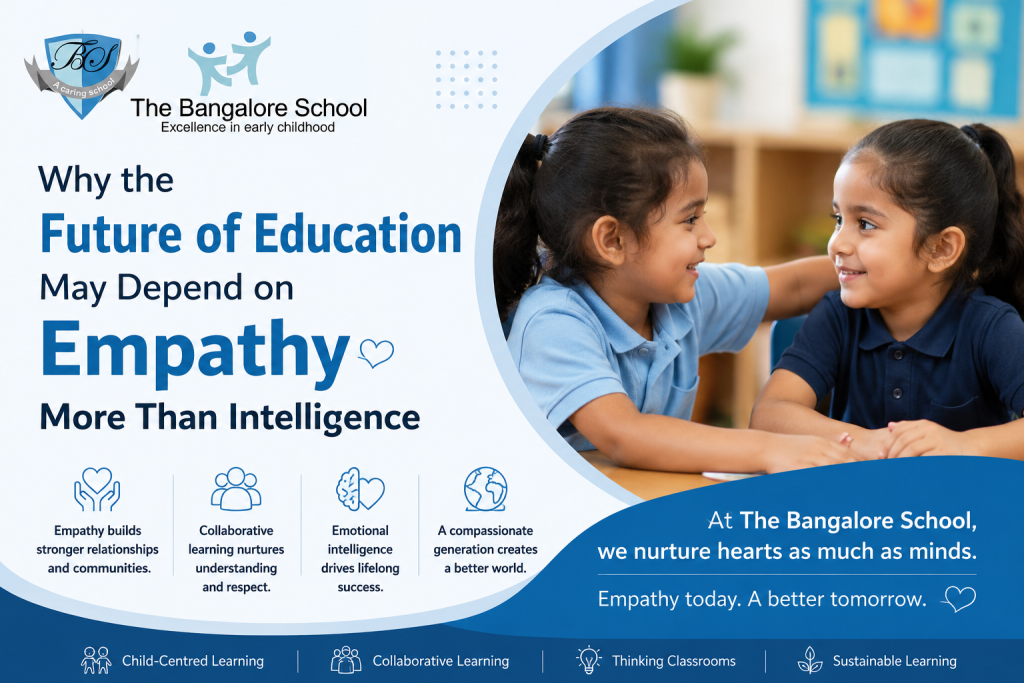
And perhaps this is why one of the most urgent conversations in education today is no longer merely about curriculum, grades, or infrastructure.
It is about empathy.
Not empathy as a decorative value written on school walls.
But empathy as the foundation of learning itself.
At The Bangalore School, this question quietly shapes the learning environment every day:
What happens to a child internally while learning?
Because learning is never only academic.
Every classroom silently teaches children something about themselves.
Some classrooms teach children that mistakes are dangerous.
Some teach them that speed matters more than understanding.
Some teach them that approval must be constantly earned.
But some classrooms teach something far more powerful:
that learning can be a space where the self expands rather than shrinks.
The Quiet Crisis Hidden Inside Modern Learning
One of the greatest paradoxes of modern education is that children today have more access to information than any generation before them, yet many are growing up emotionally disconnected from themselves.
Many children learn to answer questions without learning how to process emotions.
They learn to perform under pressure without learning how to understand their anxieties.
They learn to compete before they learn to collaborate.
They learn to seek validation before they learn self-awareness.
Slowly, learning begins to feel transactional.
The child no longer asks:
“What fascinates me?”
“What do I genuinely think?”
“What kind of person am I becoming?”
Instead, the questions become:
“Will this be graded?”
“Is this correct?”
“Am I ahead of others?”
This shift may appear subtle in childhood, but over years it deeply shapes identity.
Children begin editing their authentic selves in order to fit external systems of success.
The naturally curious child becomes cautious.
The deeply imaginative child becomes self-conscious.
The emotionally sensitive child learns concealment.
The reflective child learns to rush.
And somewhere along the way, education—which should have expanded human consciousness—begins narrowing it.
Empathy Is Not Separate From Learning. It Shapes Learning.
Empathy is often misunderstood in schools as merely being kind or polite.
But true empathy in education means something much deeper.
It means recognising that every child enters a classroom carrying invisible realities:
different fears,
different emotional rhythms,
different cognitive patterns,
different family environments,
different insecurities,
different ways of understanding the world.
An empathetic learning environment understands that children are not empty containers waiting to be filled with information.
They are developing human beings trying to make sense of themselves and the world simultaneously.
This changes the role of the educator completely.
The teacher no longer becomes merely a deliverer of content.
The teacher becomes an observer of humanity in development.
At The Bangalore School, learning spaces are increasingly designed around this deeper understanding of childhood.
The emphasis is not only on what children know.
It is also on how children experience learning emotionally, socially, and psychologically.
Because a child who feels emotionally safe learns differently from a child who feels constantly judged.
Neuroscience repeatedly demonstrates that fear narrows cognition while emotional safety expands exploratory thinking.
A child under chronic pressure often focuses on avoiding mistakes.
A child who feels psychologically secure becomes more willing to experiment, question, create, and persist through uncertainty.
And this may be one of the most overlooked truths in education:
children do not deeply learn in environments where they constantly fear inadequacy.
The Expansion of True Self
Perhaps the deepest purpose of education is not producing identical outcomes.
Perhaps it is helping children encounter their authentic selves more honestly.
At The Bangalore School, there is a growing recognition that every child carries unique ways of seeing and interacting with the world.
Some children communicate through movement.
Some through storytelling.
Some through building.
Some through observation.
Some through silence.
Some through questioning.
Yet many educational systems reward only one narrow form of visible intelligence.
As a result, children often begin disconnecting from their natural instincts very early.
The child who loves asking unconventional questions becomes “distracting.”
The child who learns differently becomes “slow.”
The deeply emotional child becomes “too sensitive.”
But true education should not erase individuality in pursuit of standardisation.
It should help children understand:
“My way of thinking has value.”
“My emotions are not weaknesses.”
“My voice matters.”
“My curiosity deserves space.”
This is the expansion of true self.
Not ego.
Not unchecked self-expression.
But the gradual development of internal clarity.
A child who understands themselves more deeply often develops greater capacity to understand others as well.
And this is where empathy becomes transformational.
Because empathy is not only about feeling for others.
It emerges from self-awareness.
Children who are allowed to recognise their own emotions, fears, strengths, and struggles often become more compassionate toward the struggles of others.
Why Human-Centred Education Matters More Than Ever
The future will not reward information recall alone.
Information is abundant.
What will increasingly matter is the ability to:
interpret complexity,
adapt meaningfully,
work collaboratively,
manage emotions,
build ethical judgement,
communicate across differences,
and remain psychologically grounded in rapidly changing environments.
In many ways, the future demands not only intelligent minds but emotionally resilient human beings.
This is why education can no longer focus exclusively on performance metrics while ignoring emotional development.
At The Bangalore School, there is an emerging understanding that qualities like empathy, reflection, curiosity, and emotional confidence are not “extra skills.”
They are foundational human capacities.
And these capacities are not developed through lectures about values alone.
They emerge through everyday experiences:
through dialogue,
through collaborative learning,
through emotionally safe classrooms,
through reflective conversations,
through opportunities to question,
through moments where children feel genuinely seen.
Because children remember how learning made them feel long after they forget individual worksheets or examinations.
Years later, many adults cannot recall every academic detail they memorised.
But they remember:
the teacher who made them feel capable,
the classroom where they felt accepted,
the moment their ideas were taken seriously,
the space where they realised they were intelligent in their own way.
Education leaves emotional imprints before intellectual ones.
And perhaps this is the deeper challenge facing schools today.
Not simply:
“How do we prepare children for careers?”
But:
“How do we prepare children to remain deeply human while navigating the future?”
Because the world may eventually have enough efficient systems, intelligent machines, and automated processes.
What it may desperately continue needing are human beings capable of empathy, reflection, authenticity, and meaningful connection.
And perhaps real education begins exactly there.